(1615) Evening all as the final scenes are played out.
21. If I don’t post these as they come up
… I’ll lose track of them with everything else going on. Pretty obvious why all this is coming out now. This is from Homer Pavlos, endorsed by Kassandra, therefore probably Orthodox:
Did Christ speak Greek? The mother tongue of Christ and the first Apostles was Aramaic. In Jerusalem at that time, which was 10 km from Bethlehem, there were at least five synagogues of Hellenistic Jews who used both Aramaic and Greek equally well. He was a Jewish preacher and later became a religious leader (the Apostles were Jews too but they also knew Greek).
Many people do not know that Hellenism in Judea was very strong back then and was embraced by many Jews. Especially in Jerusalem and Galilee. His preaching was mainly in Aramaic, and his teaching followed the Hellenistic philosophical tradition of his time. His teaching began to move away from the principles of Judaism and tended toward a new way of thinking. For that and many other reasons, he came into conflict with the dominant Jewish religion at the time.
Keep in mind that back then Judea was a province of the Roman Empire. A century earlier, the Maccabean Revolt had happened, a revolt by the Jews against the Greeks in order to keep their religion alive, because many Jews were embracing Hellenism. Although Maccabees later added elements from Greek culture in their lives.
Anyway, when the first missionaries began to go beyond Judea, the spread of Christ’s word necessarily had to be done in Greek. Greek at that time was what English is for us today: the global language of communication for people of every nationality. Christianity was first expanded explicitly and exclusively through the Greek language and culture.
The Hellenistic missionaries, therefore, and especially those who had Antioch as their center, were the pioneers in this direction. The translation of the Old Testament into Greek by the Seventy (72 Jewish scholars) constituted an important legacy for them. The 27 books of the New Testament were written from the beginning in Greek, because regardless of the original historical material or initial written sources, these texts all come from churches that used Greek as their means of communication.
Moreover, with the exception of a few passages, the books of the New Testament use the Greek Old Testament of the Septuagint everywhere. Consequently, the New Testament constitutes part of Greek literature.
Fun fact: 1. The term Hellenist (Ἑλληνιστής) is first used in Greek to describe a Greek Jew. According to the LSJ lexicon, it meant “one who uses the Greek language: a Greek Jew.” 2. “Christ” is a Greek word and derives from the Greek word “χριστός” (chrīstós), meaning “anointed one.” The word comes from the Greek verb “χρίω” (chrī́ō), meaning “to anoint.”
20. From an X commenter, re Seder
Christians should not go anywhere near it:
For Christians wishing Jews a “Happy Passover,” you’ve got no idea what you’re doing, what the holiday is actually about, or what those man-made post-temple Rabbinic traditions mean that are being observed. If you knew, you wouldn’t wish them a happy holiday.
First, keep in mind that all of the real rituals, given by God through Moses, for the real holiday, have been impossible to observe for roughly 1956 years. What they’re observing are new rites made up by rabbis, which are necessary when the thing the rituals were designed to foreshadow (Christ’s atonement) has already happened.
And what these new rituals are designed to show would blow your mind; chiefly, if you’re a Christian, it is designed as a hopeful longing for the day that God annihilates Christians and eternally damns their souls. The Seder’s fourth-cup ritual, the Shfoch Chamatkha (“Pour out Your wrath”) recitation, is explicitly directed at Christians.
Talmudic tractate sources, the Prague and Frankfurt Machzors, the Polish Siddurim, and Rabbi Abarbanel’s Sevach Pesach all confirm that the “nations” receiving four cups of divine vengeance are not some abstract theological category but Edom, which the rabbinic tradition consistently codes as Christianity. They drink it in anticipation of our destruction. But it doesn’t stop there.
The Shabbat HaGadol (the Saturday before Passover) prayer includes a petition comparing Christendom to “a ravening beast.” Day one prayers petition God to hew down the “bears, leopards, lions, and swine” (Persia, Greece, Babylon, and Rome/Christendom like pieces of slaughtered livestock.
Prayers offered on Day 2 and Day 7 aren’t any better. In fact, the entire Rabbinic Passover liturgy is built around a new typology: the Exodus from Egypt is the template, with Christians as the new Egyptians awaiting ten plagues and prayerful hope that God soon destroys us.
So while you think you’re being loving in wishing the Jews a happy and fun time at their anti-Jesus holiday, just know that they are cursing your existence and praying for your deaths and eternal destruction. “Happy Passover” is one of the dumber phrases that could ever be uttered by a Christian to a Jew. It’s not loving. It’s stupid and naive.
19. Moo corner
18. Further on what happened today
Chas3 no Easter address but Ramadamadingdong yes. Plus:





17. Zero Hedge
Trump Fires Pam Bondi As Attorney General
Update (1315ET): That didn’t take long – Bondi is out, according to Fox News and WSJ.
Bondi met with Trump in the Oval Office Wednesday night ahead of his speech to the nation on the war in Iran, where she reportedly was informed of her ouster, according to two sources familiar with the meeting.
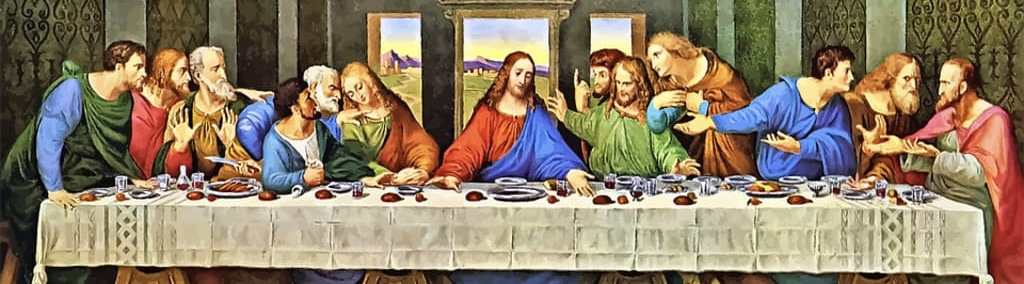
16. Why Michelangelo did not paint The Last Supper
15. Women in charge of things publicly

14. Birthright no

13. Moo corner

12. The organised western fuel crisis

13. Back in 1972/3 I used to browse those stalls. Lots of old maps and charts fascinated me, along with medical and scientific books. Between the top end of Farringdon Road and Holborn used to be a warren of streets where some of these stallholders had shops, tiny, dingy places. All gone a few years later.
Simple is best..
Why do Christians celebrate Easter?
About 2000 years ago, a man named Jesus triumphantly entered Jerusalem, where crowds welcomed him as king. A few days later, one of his disciples betrayed Him. He was arrested, without any legal basis, and tried for the crime of being the Son of God.
When Jewish authorities asked if he was the Christ, the Son of God, Jesus replied: “It is as you said.” (Matthew 26:64 NKJV) In giving this response, the High Priest claimed He had spoken against God and should be put to death. But to sentence someone to death, the Jewish leaders had to have the Roman Governor’s permission.
The Roman Governor asked Jesus if he was the King of the Jews. Jesus replied: “It is as you say.” (Matthew 27:11 NKJV)
Pilate didn’t think Jesus had done anything wrong but the priests and chief elders insisted on accusing Him. Pilate didn’t know what to do, so he sent Jesus to King Herod. Unable to get Jesus to incriminate Himself, Herod made fun of Him and Herod’s soldiers physically assaulted Him. Then Herod sent Jesus back to Pilate, as Herod also didn’t know what to do with Jesus.
It was the Jewish Passover. It was customary at this time for the Roman Governor to release one Jewish prisoner. So, Pilate gave the crowd a choice: whether to release Jesus or release a notorious prisoner called Barabbas.
The crowd, the people, chose to release Barabbas and crucify Jesus. During the Roman occupation of Israel, who was in that crowd? Roman citizens, Jews, people from across the Roman Empire? Whoever they were, it was the people who made the decision to crucify Jesus. Sin makes people do stupid things. But before we blame anyone for crucifying an innocent man, let’s remember that this happened because it was God’s will; it was according to God’s plan to save us all so that we might enter the Kingdom of Heaven and have eternal life.
The Roman soldiers flogged Jesus and then nailed Him to the cross; He was crucified just as the crowd had demanded.
Jesus died on a Friday – this is what is known today as Easter Friday. That same day, Jesus’ earthly body was placed in a tomb.
After the Sabbath, on Sunday – now known as Easter Sunday – Mary Magdalene and some other women went to Jesus’ tomb. But His body was not there. Afterwards, Jesus appeared to Mary Magdalene and His disciples, proving He had risen from the dead to offer salvation and eternal life.
Did Judas really betray Jesus in the manner Christians have been told? It was His destiny, so we have been taught, that he would die to.absolve humanity of it’s sins, but would then rise to continue his message, one that continues even after death. In order for this to happen, Jesus would have to be located, and arrested by people who may not know what he looked like, so a means of identifying him in a crowd was necessary. This is where Judas Iscariot came in.
It is feasible that Judas loved Jesus more than anyone, and was prepared to make his own ultimate sacrifice to fulfil God’s destiny. He knew that, in identifying Jesus, his lineage, very important in the Jewish religion, would end with him, as no woman would willingly marry the man who betrayed Christ, and that his name would last through the ages as the greatest betrayed of all.
So, was this plan of betrayal made between Jesus and Judas? At the last supper, Jesus is said to remind Judas that he had somewhere to go. It had to look genuine, which is where the 30 pieces of silver, as the price of this betrayal, may come in.
Despite this possible agreement, Judas could not come to terms with his part in this, and full of remorse, committed suicide, another sin in the Jewish religion, hoping that God would forgive him for this. We shall never know until, perhaps, the end of days.
The above is a shortened form of a conversation between an Army Chaplain and myself, when we were on night duty during a military exercise, he was using the time to prepare for an Easter talk on BFBS, and using me as a sounding board. In the event, he mentioned our conversation, received a commendation from his senior officer, and I received a bottle of single malt from him.
At this time of year, I often think of that might time duty and that conversation.
……
JH: Ta, Penseivat.
I have heard and read of this interpretation of Judas’s role in the betrayal of Jesus in many places. I do give it some credence.