(0559) Dark out there. (0814) Not dark now. (0815)
5. The attack on Pearl Harbour
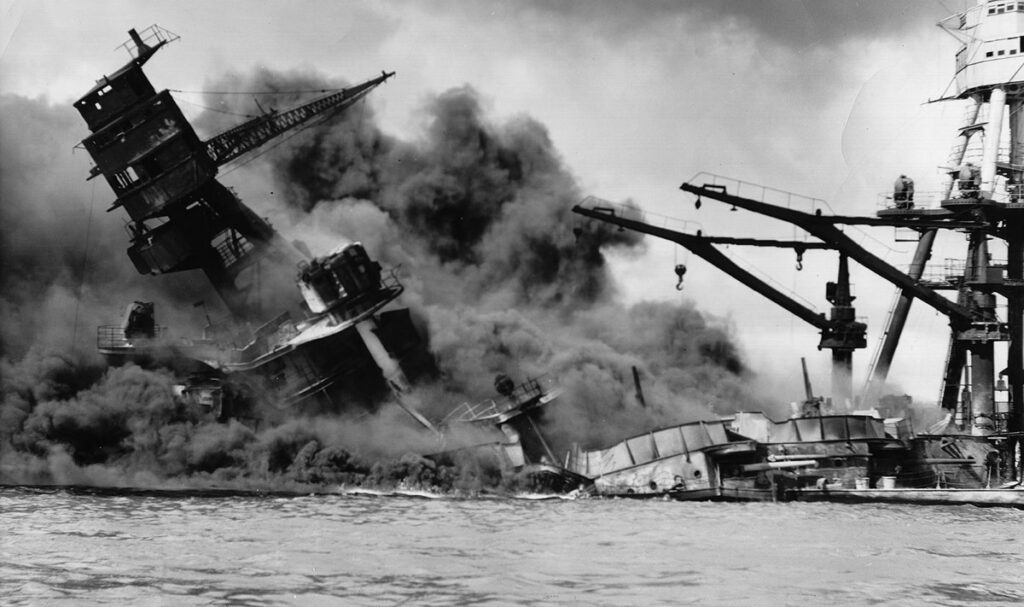
What can we possibly add? Wiki:
Over the course of seven hours, there were coordinated Japanese attacks on the American-held Philippines, Guam, and Wake Island and on the British Empire in Malaya, Singapore, and Hong Kong.[17]
Does it help to remember this particular history and what led to it?
4. A quote within a tweet within a fellow blogger’s post

3. Steve at 1224
- Watchdog Claims US Weapons Left Behind by Biden in Afghanistan Now Make Up ‘Core’ of the Taliban Military
- Medical Doctor Confirms: There Are Only Men and Women – The Rest Is Trans Ideology
- Election Interference and Migration: EU Pumped Over $542 Million Into Four USAID-NGOs
- 10 Dead, At Least 19 Injured in Car Ramming Attack on Christmas Market in France’s Guadeloupe in the West Indies
- West Virginia National Guardsman Andrew Wolfe ‘Slowly Healing’ After D.C. Shooting
- Assistant AG Harmeet Dhillon Reveals that 260,000+ Dead Voters, Thousands of Illegals are Registered to Vote in 2026 After Limited Review of State Voter Rolls – 15 Lawsuits Pending Against States for Refusing Record Review
- Ukraine Admits Losses Following Massive Russian Group Strike
- Real-world testing reveals EVs consistently fail to meet advertised range
- The War on Pete Hegseth
- Much more.
2. The philosopher George Santayana wrote
“Those who cannot remember the past are condemned to repeat it”.
This quote is from his 1905 work, The Life of Reason, though it’s also variously been attributed to Burke, Churchill and others … and though the core idea is right, it’s also fraught. The other day, in the course of the day’s doings, I heard someone say that he was never really interested in history as cold, hard dates and events, only insofar as a particular history pertains to our current events.
Uh huh … and how would he know what pertained from the past and what didn’t, in order to make that considered judgement, unless he were widely read about the past? I’m thinking he meant that not all in-school histories were ever going to be all that relevant, just as how much trigonometry was going to impact the ordinary person’s life? How much calculus? That’s fair.
Is it also fair that a teacher decides what his class should know according to his/her whim, or even his/her heavily feelings-laden ideological narrative, usually handed down via the politburo? The Ministry of Truth? A la Ardern’s single point of truth in NZ?
Who decides which history comes down through the ages … and which does not? Is that the preserve only of the victors of wars? Or should every bit of pretty much verified knowledge, e.g. an archaeological artifact or a rock etching or papyrus be taught the children at some stage from early primary to late secondary, at which point the child starts to specialise?
So that he/she, at around 16/17, starts to see which course to pursue, which to leave for the moment?
I was never a history teacher in any formal sense, though history formed part of any topic, e.g. a nation’s culture. Do we teach that the St Bartholomew’s massacre was a good thing … ridding ourselves of pesky protestants … or is it an appalling stain upon the nation, where elite-ordered mob violence was visited upon those the boss didn’t like much? Those who’d been causing trouble? A la Thomas à Becket?
On the other hand, the Old Testament of the bible can maybe help. “The Bible verse commonly associated with increasing knowledge is Daniel 12:4: “But you, Daniel, shut up the words and seal the book until the time of the end. Many shall run to and fro, and knowledge shall increase”.”
That’s been interpreted by many scribes and pundits as referring to the end times, in which, as Yuri Bezmenov noted … demoralised populations will run around, unable to reason, only to take on board the Fabian marxism from above, from the pointyhatters. The real knowledge is lost in the swirling storm of faux “facts”, or irrelevancies, such that wise sages need first sort the wheat from the chaff before even seeing where it leads. And of course Tower of Babel type striving for some sort of knowledge nirvana to out-god God.
A biblical scholar has precedent to draw on in seeing how all that can only lead to trouble and strife across a nation, culture … across the entire west. A Christian, non-denominationally, can instantly see where such a course leads and who is ultimately behind such diabolical, civilisation-ending horror. A being whom most children are kept unaware of or adults are then in denial about.
Which leads me to a song quote to finish up this post item for now: “Зачем тебе знать” or “For what for you to know”?
1. DAD at 1224
a) Nantes in the news – again. But this time it is GOOD news. “The Living Heritage Association invite you to experience the spirit of Christmas through its Grand Living Nativity Scene: a performance featuring nearly 250 volunteer actors….
b) “If you dig up LGBTQI people in 200 years, you’ll only find the skeletons of men and women….” JH: plus children
c) Louvre … it is now the turn of the Department of Egyptian Antiquities to be struck. Specifically, its precious library….
d) During rush hour, prime time for groping, or on deserted platforms in the evening, many women are on high alert as assaults increase….
e) “We take our responsibility as parents seriously, but this is not the solution”: after a series of attacks
I realise that I was educated in a different time to most of you who read this site, but I was taught that the word ‘fraught’ should be followed by ‘with xxxx’. The word represented by xxxxx having negative connotations.
As I found in an old book on English grammar ….
“It is a mistake to use “fraught” alone without “with” Always say “fraught with” before the issue or characteristic “Fraught” is a modifier; it lacks clarity unless it is paired correctly.
Can we blame our Colonial cousins changing the glory of the English language into a mish-mash of illegitimate precepts?
Can’t speak here about DAD’s cousins in other parts of the world, but in England we used Oxford as the main source of reference and a side volume I always liked was Angus Maciver, First Aid in English, first published by R Gibson, Glasgow, in 1938 … he was admittedly a Scot.
Oxford gives, as examples:
“It seems likely to make domestic life more fraught, rather than less.”
“Falling in love and getting married will be fraught with danger.”
Fraught by itself means liable to or possibly causing stress or undesired consequences. “Fraught with” indicates in which way fraught. Both usages were always perfectly acceptable.
There are many areas of usage where someone was taught one way but failed to be taught the full usage, for example, I was taught never to open a sentence with a conjunction or with a verb, minus subject. Thus I should not open with: “Can’t speak here about …” but rather: “I can’t speak here about …”
The problem there is that opening with a personal pronoun is held, by sticklers, to be poor usage, yet usage does change over time and it reads better without, especially in a post.
Then we could get onto the Oxford comma.
Of course, I can only speak of the situation in England, pre-1970.
…
I would add, just for fun, that though (it should be “although” or maybe “while”) Oxford agrees to (with) fun as an adjective, it was not traditionally so and examples given do not include, for example, a “fun activity”. It does give “that was fun” or “that was a bit of fun”.
Therefore, I did not argue with Dearieme over his apoplexy, I just made fun of it.
5. The attack on Pearl Harbour – during the attack the light cruiser USS Phoenix made it out of the harbour unscathed. We know her as the General Belgrano when she appeared on the front page (4 May 1982) of the Sun newspaper, together with the headline ‘GOTCHA’.
Sinking of the Belgrano | Falklands War Original News Broadcast (1982) | https://www.youtube.com/watch?v=KXnbq41yqJU
“he was admittedly a Scot.”
Good God, man, all the good dictionaries were produced by Scots. Murray from Hawick produced the OED, Collins is a Glasgow firm, Chambers an Edinburgh firm.
It also means you get a diversity of linguistic backgrounds: Murray in his playground years would have spoken Southern Scots, the Glaswegians Western midScots and the Edinburghers Eastern midScots. Outwith the playground I expect they spoke ordinary Scottish English with their parents and schoolteachers – in different accents, presumably, but none involving the swallowing of syllables, the softening of consonants, or the diphthongising of vowels. So that would have given them an advantage over their English contemporaries.
Apart from these three only Dr Johnson’s matters, but as an interesting historical relic rather than a dictionary for everyday use.
……
JH: I (cough) did nae want to restart a linguistic Culloden or Bannockburn. 😎
And yes, the best texts in English grammar and usage were Scot or Johnson … was that, d’you think, because the Scots are generally so pernickety? And what of Johnson?
Apropos Scots English versus English English, forget our colonial cousins, I always found that the Scots I knew who had an education spoke English more clearly and precisely than most English people.
Does that sentence make sense? Is it a correct usage? Ought it to have been two sentences? Oh Lord, I will not be able to comment here in future in fear of a clip around the ear from teacher.
I was learnt in Scotland! (At least, that’s what we would say in the playground….)
However, since I was of English descent, my mother spoke proper English – with a BBC accent according to the Scots – so I was suitably appalled but kept silent as I was only accepted if I spoke with a Scottish accent and in the Scottish way.
Pearl Harbour: FDR had been provoking the Japanese and the mugs fell for it. By God they paid a price for having loopy warmongers in charge.
The Japanese I mean. The Americans didn’t start paying a price for their loopy warmongers until after 1945.
5. I seem to recalling told, long after the war, that the American expansion into the Far East was stifling, or strangling, Japan’s trading with other countries, especially in the production of steel, the basic ingredients Japan had little of. If true, it was unfortunate that the militaristic ideology and pressure to invade other countries to obtain these metals, and take revenge on the USA, happened at roughly the same time.
Off topic, my Uncle Kenny survived the war in Europe, was sent to the Far East, and was one of the last British soldiers to be killed.