(0812) Morning again, all. (0827)
5. Mr. Gobby’s twofer
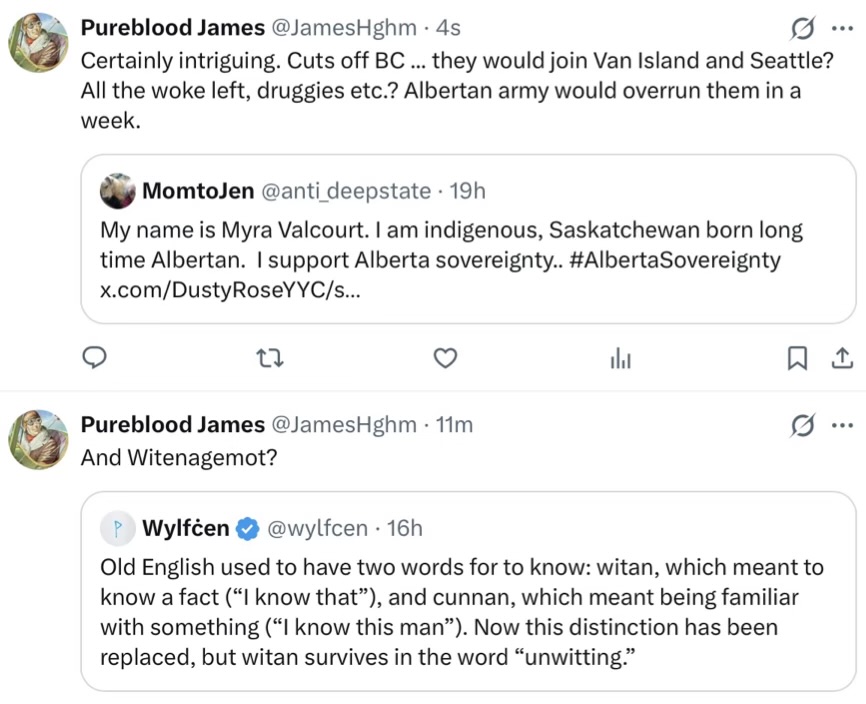
4. DAD at 1279
a) VPNs in France are the next on the agenda. Banning social media for those under 15: “Yes, VPNs exist, but if this legislation allows me to protect a very large majority of children, we will continue.”
b) This behavour is on the rise in France – mass rapes by teenagers in the basements of blocks of flats.
c) Image is more important than violence ! “We are not in a cutthroat France or a Clockwork Orange…”: Laurent Nuñez, Minister of the Interior, acknowledges a “rise in violence”….
d) Here is one group who will not be in my Will. In an internal document dated December 13, exclusively revealed by L’Incorrect, the APF France Handicap association calls on its members to maintain no ties with parties described as “far-right”…..
3. Toodles at 1280
A bit of light relief.
“Old English” is a misnomer. It should really be called Insular West Germanic. It doesn’t become English until it forms a creole with Norman French.
……
JH: Yes.
As usual you don’t know what you’re talking about. It’s called Old English because its the earliest recorded form of the English language. The Modern English we speak today evolved from Middle English – of writers such as Geoffrey Chaucer. My ancestors would confer in the West Saxon dialect of Old English: the vernacular for over 700 years. Some of it survived into the 19th Century in rural areas.
It’s a creole: it ain’t English until the two streams mix.
An AI tells me ‘Late 19th Century: “Old English” began to officially replace “Anglo-Saxon” as the standard scientific term among linguists’.
Perhaps the dons at Oxford didn’t like the obvious German-ness of “Anglo-Saxon”. Was it a reaction to Bismarck or to Kaiser Bill? Dunno but I do wonder why they changed it.
You’ll have to do better than that – surprised your AI didn’t mention the Great Vowel Shift (15th-17th Century) when the language evolved from Middle to Early Modern English. Folk like my Mum, who spoke Welsh, wouldn’t understand Middle Welsh. Languages evolve along linguistic lines but it doesn’t make them ‘creole’, which has no meaning in this context. I give you 1/5 for effort.
https://www.thehistoryofenglish.com/old-english
Well isn’t this fun!
Think we’ll draw a line under the acrimony, all right, gentlemen … just the facts, sirs.
‘A creole language, or simply creole, is a stable form of contact language that develops from the process of different languages simplifying and mixing into a new form (often a pidgin), and then that form expanding and elaborating into a full-fledged language with native speakers, all within a fairly brief period’ – Wiki
That didn’t happen with what we now call Old English, even after the Norman Conquest the vernacular remained the same for hundreds of years. Not at all a ‘fairly brief period’. Most folk were illiterate anyway and spoke their native tongue, or nothing. It was the Norman elite who had to change, for instance the Anglo-Saxon Chronicle was still in West Saxon long after William I died. On the tree of Indo-European languages English sits alongside German, Dutch and Scandinavian. There is no branch labelled ‘creole’ for English. Those are the facts, James.